
Every con starts with a good number. “Twice the weight loss of Ozempic” is a good number. It moves. People repeat it at parties, in comment sections, in DMs from guys selling vials. Nobody asks where it came from. I did.
This isn’t a takedown and it isn’t an endorsement. It’s a trail. I want to show you how I ran it down, because the method matters more than my opinion of the drug. Follow the same steps on the next miracle claim that lands in your feed. You’ll thank me later.
Lead one: find the paper the number is hiding behind
A claim without a source is just a rumor with better lighting. So I went looking for the study behind “10% weight loss, twice the approved drugs.”
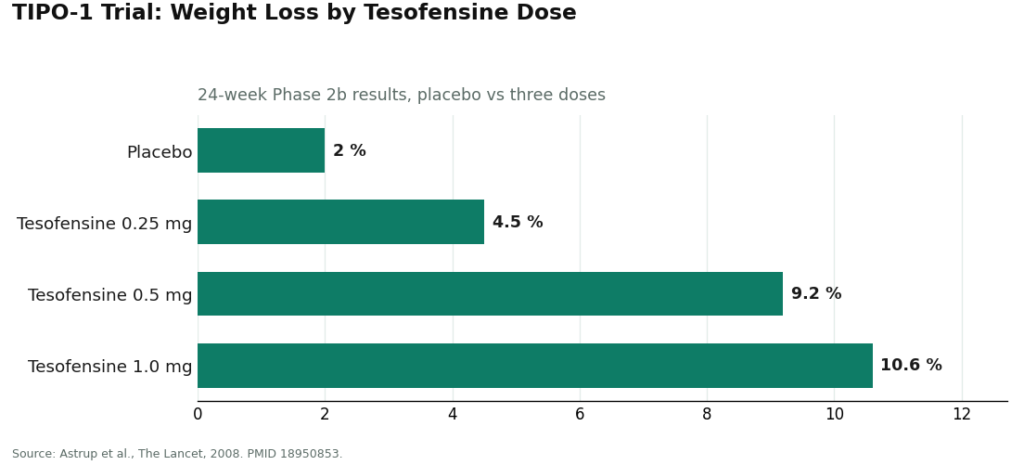
Found it. One paper. A Phase 2b trial called TIPO-1, published in The Lancet in 2008, sitting in plain sight on PubMed under PMID 18950853 [P1]. Randomized, double-blind, placebo-controlled. 203 people, BMI 30 to 40, five obesity centers in Denmark, everyone on a calorie-restricted diet, 24 weeks on the clock. Three doses of tesofensine, 0.25, 0.5, and 1.0 mg, stacked against placebo.
The numbers check out. Weight loss came in at 4.5%, 9.2%, and 10.6% across the rising doses. Placebo group lost 2.0% [P1]. So the number is real. It exists. It’s not fabricated.
But here’s what the headline left out of the file: it’s one trial. Phase 2, not Phase 3, not the finish line. And the flashy 10.6% belongs to the top dose only, the one nobody kept.
Lead two: read what the authors actually signed their name to
Marketers lift the sentence that sells. They bury the one right next to it that doesn’t.
Here’s the full quote, both halves. The authors said the 0.5 mg dose “might have the potential to produce a weight loss twice that of currently approved drugs.” Same sentence, same breath, they said the finding “needs confirmation in phase III trials” [P1]. The hype types stopped at the semicolon.
That second half isn’t fine print. A Phase 2 result is a reason to run a bigger trial, not a verdict. The people who ran the study are telling you, in their own words, that they don’t know yet either.
And “currently approved drugs,” as of when? 2008. The weight-loss options on the shelf that year were nothing like what’s available now. GLP-1 drugs in their modern form didn’t exist yet. So “twice the approved drugs” meant twice a weak field, not twice semaglutide or tirzepatide. Always ask what year the comparison is standing in.
Lead three: subtract the alibi
The placebo group is the alibi witness. It tells you what would’ve happened with nothing but diet, attention, and time. Skip the subtraction and you’re quoting the suspect’s own story as fact.
Do the math. Top dose: 10.6% minus the placebo’s 2.0% leaves the drug’s real contribution at about 8.6%. Mid dose: 9.2% minus 2.0% is roughly 7.2% [P1]. Still solid, mid-stage numbers. Not nothing. But not the clean double-digit figure getting passed around either. The gap between 10.6 and 8.6 is exactly the kind of daylight that disappears when someone’s selling you something.
Lead four: check for the wound nobody mentions
Efficacy travels light. Safety gets left at the scene. I went looking for the wound.
Found it fast, it wasn’t hidden. Heart rate climbed about 7.4 bpm in the 0.5 mg group [P1]. Then I widened the search. A 2008 meta-analysis of earlier trials run for Parkinson’s and Alzheimer’s, PMID 18356831, found the same pattern in people who weren’t even dieting: a dose-dependent heart-rate bump up to about 6.8 bpm [P2]. Two separate studies, same signal. That’s not a fluke. That’s a pattern.
And notice this detail: the 1.0 mg dose, the one with the best number, also pushed blood pressure high enough that it got dropped from later development. The doses that survived were capped at 0.25 and 0.5 mg, specifically to keep the heart rate issue in check. When the best-performing dose gets cut for safety, that’s the file telling you something. Read the efficacy number alone and you’d never see it.
Lead five: follow what the developers actually did, not what they said
Words are cheap. Money and lab time are not. So I checked the registry to see what the drug’s own people spent effort trying to fix.
This is the one that clinched it for me. ClinicalTrials.gov, record NCT03488719. A company called Saniona ran a Phase 1 study for one purpose only: find the dose of metoprolol, a beta blocker, needed to cancel out tesofensine’s heart-rate increase. Their own paperwork says heart rate “has been shown to be the most affected safety endpoint by the effects of tesofensine.” The trial got halted over safety concerns, then closed for good in 2019 [P5].
You don’t build a companion drug study to fix a footnote. You build one to fix a problem. And the fact that the fix got shut down without finishing tells me the problem wasn’t an easy one. Actions over statements, every time.
Lead six: don’t confuse “not caught” with “cleared”
There’s a difference between “we looked and found nothing” and “we never really looked.” Mixing those up is how people talk themselves into bad bets.
Tesofensine cranks up serotonin, norepinephrine, and dopamine, the same chemistry psychiatric drugs work on. Reasonable to worry about mood effects. But check who was actually in the obesity trials: people with known psychiatric history were screened out. The population most likely to show a bad mood reaction wasn’t in the room. So the quiet mood data in the published record doesn’t mean the drug is clean on that front. It means the test was never really run on the people who’d answer the question. Call it under-characterized. Don’t call it cleared.
Lead seven: let the mechanism name its own enemies
Sometimes you don’t need a new study. The mechanism tells you where the bodies are buried.
Tesofensine blocks serotonin reuptake. That fact alone predicts trouble. Combine it with an MAOI and you’re looking at serotonin syndrome and a blood pressure spike. Stack it with SSRIs, SNRIs, stimulants, or bupropion and you’re doubling up on the same circuit. Nobody needed a dedicated interaction study to see this coming, the chemistry already wrote the warning label. And these aren’t rare drugs. SSRIs and stimulants are some of the most commonly prescribed medications in the country. This isn’t an edge case. It’s a crowd.
Lead eight: pin the drug’s actual legal status to the wall
Last stop. Where does this thing actually stand with regulators, in plain words, not marketing words.
Plain words: not FDA-approved. Classified in the US as an investigational new drug. No US approval in the 17 years since that 2008 trial. The rights changed hands from NeuroSearch to Saniona in 2014. The most active development since has run through a partner, Medix, in Mexico, not through the FDA. The furthest anything has gotten anywhere is a favorable opinion from a technical committee at Mexico’s COFEPRIS in early 2023, a procedural step in one country, not an approval, not an FDA action. As of mid-2026, by the public record, tesofensine is approved for obesity nowhere. Where you can get it in the US, it’s a compounded medication through a licensed pharmacy, on a prescription. That’s a different category than an FDA-approved drug, and the difference matters.
The one thing that holds
Run all eight leads and here’s what’s left standing when the smoke clears. The efficacy signal is real. One well-run 2008 Phase 2 trial, clean dose-response, oral once-daily, a mechanism that’s genuinely different from the GLP-1 drugs, and roughly 10% total weight loss at the top dose [P1]. That’s why anybody’s still talking about this compound seventeen years later.
But the same digging surfaces everything the hype buries in the same breath: the honest drug effect shrinks to somewhere around 7 to 9% once you subtract placebo; there’s a real, repeated cardiovascular signal serious enough that the best dose got benched and a whole companion study got built and then killed [P2][P5]; the mood question was never really tested on the people who’d show a reaction; the interaction list runs straight through some of the most common prescriptions in America; and the Phase 3 the original authors said they needed never happened, not in seventeen years. None of that erases the efficacy number. It just sits next to it, where it belongs.
The call
Here’s what the file actually points to. The two things that kept coming up, the heart rate and the drug interactions, are exactly the two things nobody can watch on their own. You can’t trend your own resting heart rate against a known side effect with any rigor. You can’t reliably cross-check a vial against your own medicine cabinet for serotonin overlap. That takes someone else in the room.
Which is why, on a compound with a file that reads like this, I land on supervised over unsupervised, and it’s not close. Where tesofensine is legally available in the US, it moves through a licensed 503A compounding pharmacy on a prescription. Because it’s a small molecule and not a peptide, it slipped past the FDA’s peptide-compounding restrictions and stayed on the compounding pharmacy shelf.
A supervised telehealth outfit like FormBlends works like a clinical service, not a chemical shop off a research-chem site. A clinician takes your baseline heart rate and blood pressure, runs your medication list against the interaction risks, decides if a dose even makes sense for you, and keeps checking afterward. That’s why FormBlends sits at the top of my list here, and for the same reason HealthRX (healthrx.com) earns the number two spot: both keep a clinician in the loop instead of leaving you to play doctor, pharmacist, and monitor all at once.
Compare that to the other tier, the research-chemical trade, where the same molecule gets sold labeled “for research use only, not for human consumption,” the loophole that lets it exist on a shelf at all. Buy there and you’re the whole safety system. For a drug whose own developers couldn’t engineer around its cardiovascular profile, that’s a bad bet.
What I’d tell you to actually do
The real find here isn’t a verdict on tesofensine. It’s the method. Find the study. Read the authors’ full conclusion, not the highlight reel. Subtract the placebo yourself. Go hunting for the safety signal nobody quoted. Check what the developers actually spent money doing. Keep “not studied” and “shown safe” in separate drawers. Let the mechanism tell you who the drug fights with. Pin the regulatory status down in plain words.
Run those eight leads on tesofensine and you get a picture that’s more honest than the hype and more useful than a shrug. Run them on the next “beats Ozempic” claim that crosses your feed, because there will be a next one. Next time, you check it. You don’t just believe it.
Questions worth answering
Is tesofensine really twice as effective as Ozempic? No, and it doesn’t survive a close read. The “twice the approved drugs” line comes straight from the 2008 TIPO-1 authors describing the 0.5 mg dose against the weight-loss drugs sitting on shelves in 2008, which were far weaker than today’s GLP-1 drugs, and they flagged even that as needing Phase 3 confirmation. The comparison was never against semaglutide or tirzepatide, neither of which existed in their current form back then.
What was the actual weight loss in the tesofensine study? The top 1.0 mg dose hit 10.6% total weight loss over 24 weeks, but the diet-plus-placebo group lost 2.0% on its own, so the drug’s real, placebo-subtracted contribution comes to roughly 8.6%, and around 7.2% at the 0.5 mg dose. Strong mid-stage numbers. Smaller than the raw headline suggests.
Why was the most effective dose of tesofensine abandoned? The 1.0 mg dose, the strongest performer, raised blood pressure enough that developers dropped it from later trials, keeping the doses that moved forward capped at 0.25 and 0.5 mg to hold the cardiovascular effect in check. Dropping your best dose for safety isn’t a footnote. It’s a signal.
Is tesofensine FDA-approved? No. As of mid-2026 it’s classified in the US as an investigational new drug, with no US approval in the seventeen years since that 2008 Phase 2 trial. The furthest anything’s gotten anywhere is a favorable opinion from a technical committee at Mexico’s COFEPRIS in early 2023, a procedural step in one country, not an approval and not an FDA action.
What are the main safety concerns with tesofensine? Two keep surfacing. A real, repeated cardiovascular signal, a dose-dependent heart-rate increase seen across multiple trials, serious enough that developers built and then shut down a companion beta-blocker study. And a serotonergic interaction profile that overlaps with very common drugs like SSRIs, SNRIs, MAOIs, stimulants, and bupropion. The mood data are also thin, since the obesity trials screened out anyone with a known psychiatric history.
How can I check a “stronger than Ozempic” claim myself? Run the same leads I ran here on any compound: find the study behind the headline number, read the authors’ full conclusion instead of the one flashy clause, subtract the placebo arm yourself, go hunting for the safety signal the marketing skipped, check what the developers actually did in the trial registry, keep “not studied” separate from “shown safe,” let the mechanism predict the interactions, and pin the real regulatory status down in plain words.
What is tesofensine, and where does it come from?
Tesofensine is a small-molecule triple monoamine reuptake inhibitor. It slows the reabsorption of dopamine, serotonin, and noradrenaline in the brain. NeuroSearch originally built it for Parkinson’s and Alzheimer’s disease, and along the way patients in those trials kept losing weight as a side effect. That’s what pivoted the research toward obesity and produced the TIPO-1 trial that most of today’s hype traces back to.
Is tesofensine a peptide like semaglutide or tirzepatide?
No. It’s a small synthetic molecule, closer in family to older appetite suppressants like sibutramine than to GLP-1 receptor agonists. That distinction has real consequences: it’s a pill, not an injection, and its mechanism, side effects, and cardiovascular risk profile are a different animal from the peptide drugs dominating the headlines right now.
What does tesofensine actually do in the body to cause weight loss?
It works through the brain, not the gut. By blocking reuptake of dopamine, serotonin, and noradrenaline, it raises circulating levels of all three, which suppresses appetite and may nudge resting energy expenditure up a bit. The TIPO-1 trial showed meaningful drops in calorie intake among participants. Whether there’s a real direct fat-burning effect stacked on top of eating less isn’t clearly settled in the published data.
What is tesofensine currently used for, and can you legally get it?
No approved use anywhere, not in the US, not the EU, not most major markets, as of mid-2025. It never finished Phase 3. In practice it moves through two very different lanes: research-chemical and grey-market supplement sites, which carry the risks you’d expect, and physician-supervised compounding pharmacies, where outfits like FormBlends operate under pharmacist oversight and actual accountability. Step outside that supervised lane and you’re in a legal and safety grey zone worth taking seriously.
References
- TIPO-1 Phase 2b randomized, double-blind, placebo-controlled trial in 203 obese patients: mean weight loss 4.5% / 9.2% / 10.6% at 0.25 / 0.5 / 1.0 mg vs 2.0% placebo over 24 weeks; heart rate +7.4 bpm at 0.5 mg; authors concluded the 0.5 mg result needs Phase 3 confirmation. Astrup et al., The Lancet, 2008. PMID 18950853. https://pubmed.ncbi.nlm.nih.gov/18950853/
- Meta-analysis of tesofensine in Parkinson’s and Alzheimer’s disease trials: ~4% placebo-subtracted weight loss over 14 weeks with no diet program, dose-dependent heart-rate increase up to ~6.8 bpm. Astrup et al., Obesity (Silver Spring), 2008. PMID 18356831. https://pubmed.ncbi.nlm.nih.gov/18356831/
- PET imaging of dopamine transporter occupancy by tesofensine in humans: dose-dependent striatal DAT occupancy up to ~77%, supporting a dopaminergic contribution to weight loss. Appel et al., European Neuropsychopharmacology, 2014. PMID 24239329.
- Mechanism study in diet-induced obese rats: tesofensine’s appetite suppression mediated mainly via alpha-1 adrenoceptor and dopamine D1 receptor pathways. Axel, Mikkelsen, Hansen, Neuropsychopharmacology, 2010. PMID 20200509.
- Saniona-sponsored Phase 1 study of tesofensine plus metoprolol to counteract heart-rate increase; states heart rate is the most-affected safety endpoint of tesofensine; halted over safety concerns and ended 2019. NCT03488719.
- Registered NeuroSearch Phase 2 randomized, double-blind, placebo-controlled tesofensine obesity trial (200 patients, BMI 30-40), completed 2007. NCT00394667.